
Why No One Warned You How Hard the Newborn Stage Would Be
You were told it would be tiring. You were shown the cute onesies and the tiny socks. Someone probably said, "Sleep now while you can," with a knowing little laugh. But nobody sat you down and told you the truth: that the newborn stage can feel like being broken open and asked to keep functioning anyway.
If you are in the thick of it right now — bleary-eyed, unshowered, holding a baby who will not stop crying at 3 a.m. and wondering what on earth you signed up for — I want you to hear something. You are not weak. You are not doing it wrong. This stage is genuinely, structurally, one of the hardest things a human being can be asked to do.
Let's talk honestly about why — and about what the science actually says is happening to you.

The newborn stage isn't hard because you're failing at it. It's hard because it is hard — and no highlight reel prepared you for that.
Why the Newborn Stage Is So Uniquely Brutal
There is a reason this period breaks so many capable, loving people down. It's not one thing — it's all of them at once.
Total sleep deprivation. Newborns wake every two to three hours around the clock. You are not just tired; you are being asked to make decisions, regulate your emotions, and keep another human alive on a level of sleep loss that in other contexts is used as an interrogation technique.
Round-the-clock demand. There is no clocking out. No lunch break. No "I'll finish this tomorrow." The needs are constant and immediate.
A body in recovery. Whether you birthed your baby or not, the postpartum body is healing, flooded with hormonal shifts, and often in pain.
Loss of identity and control. Your old life — spontaneity, hobbies, a predictable body, uninterrupted conversations — has vanished overnight. That is a real loss, even when the baby is wanted and loved.
Isolation. So much of this happens alone, in a quiet house, at hours when the rest of the world is asleep.
Stack those on top of each other and the exhaustion you feel starts to make complete sense.
The Sleep Loss Is Real — and It Lasts Longer Than You'd Think
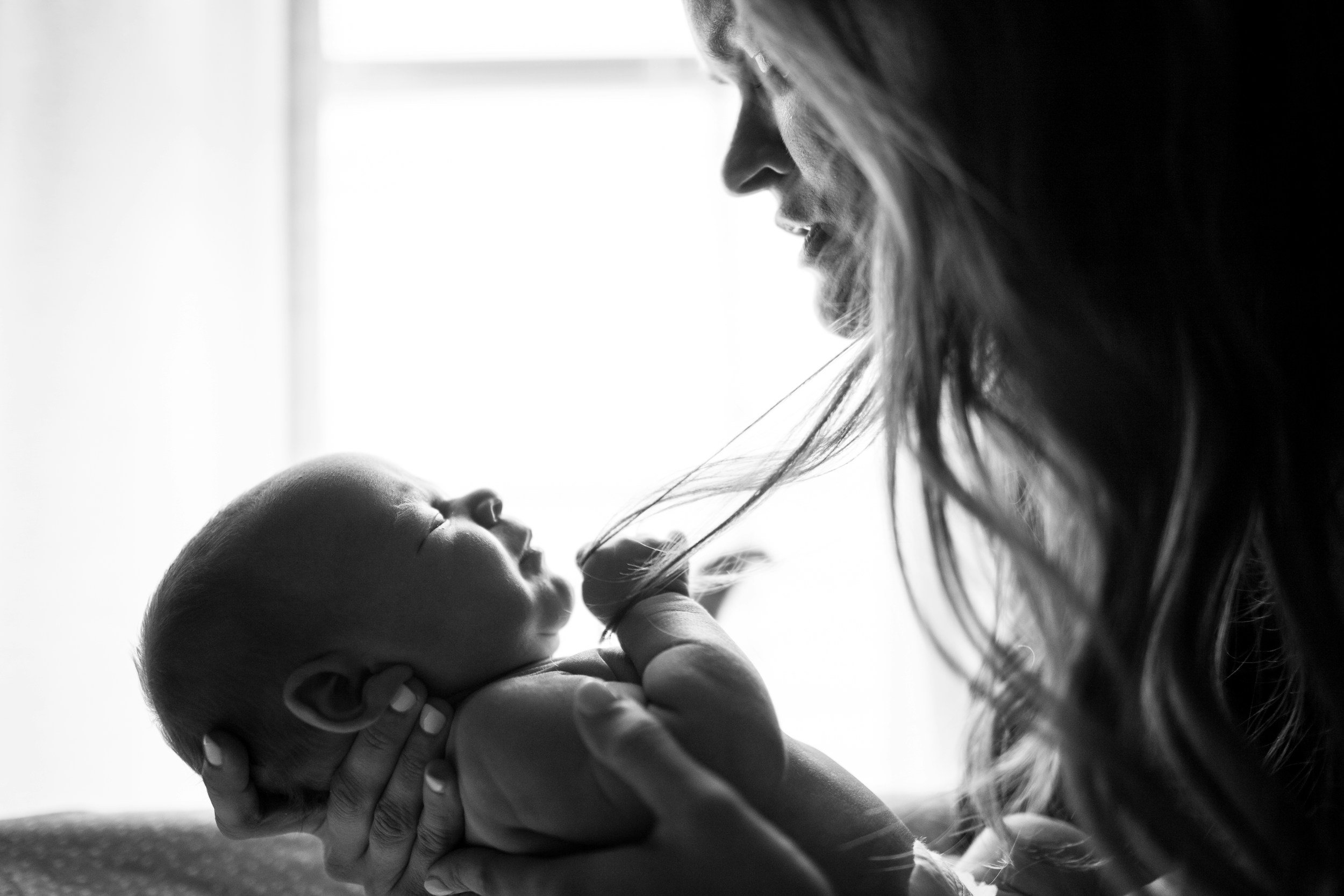
You are not imagining how hard this is. You are running one of the most demanding stretches of your life on the least sleep of your life.
If you feel like your brain is broken, there's hard data behind that feeling. A 2019 study that tracked more than 2,500 parents' sleep from before pregnancy through six years afterward found that sleep satisfaction and duration dropped sharply in the first months after birth — mothers lost around an hour a night in that period — and, strikingly, did not fully return to pre-pregnancy levels even six years later (on how childbirth affects parents' sleep, 2019, *Sleep*). The takeaway isn't despair; it's permission. You are not imagining the depth of this, and you are not supposed to be "over it" in a week.
Chronic sleep loss isn't just uncomfortable — it directly degrades mood, patience, and clear thinking. Pooling the controlled experiments, a 2010 meta-analysis found that even short-term sleep restriction measurably erodes attention and cognitive performance — and that people tend to badly underestimate how impaired they actually are (a meta-analysis on sleep deprivation and cognition, 2010, *Psychological Bulletin*). In plain terms: when you're running on newborn sleep, you are genuinely operating with less of your brain online, even on the days you think you're managing fine. Be gentler with yourself accordingly.
You Are Becoming a Different Person — Literally
Part of what makes this stage so disorienting is that it isn't only exhausting; it's transformative in ways no one names. There's a word for it — matrescence — the profound developmental transition into motherhood, akin to adolescence in the scale of its physical, hormonal, and identity upheaval, a concept brought back into wide conversation in 2017 by reproductive psychiatrist Alexandra Sacks ("The Birth of a Mother," *New York Times*, 2017). Naming it matters, because the push-pull you may feel — loving your baby fiercely while grieving your old self — isn't a defect. It's the normal ambivalence of becoming someone new.
Neuroscience backs this up in a way that still amazes me. Brain scans taken before and after first pregnancies have revealed lasting changes in the structure of new mothers' brains — reductions in gray matter in regions tied to social cognition, changes that appear to help mothers attune to their infants and that lasted at least two years (on how pregnancy reshapes the brain, 2017, *Nature Neuroscience*). Your brain is being physically remodeled for this job. Of course it feels like the ground is moving — it is.

Everyone posts the sleeping baby. No one posts the third hour of screaming.
Why No One Warned You
If it's this hard, why does everyone act like it's just tiring?
Part of it is cultural amnesia. The fog of the newborn stage is so disorienting that many parents genuinely don't remember the worst of it once it passes — a kind of protective forgetting. Part of it is social pressure: we're taught that a "good" parent, especially a "good" mother, should be grateful and glowing, so admitting that it's miserable can feel like a confession of failure.
And part of it is the highlight reel. Social media serves up soft-focus photos of sleeping babies and matching pajamas, not the 4 a.m. sobbing or the resentment or the touched-out numbness. When your reality doesn't match the images, it's easy to conclude that something is wrong with you — when really, you're just seeing the edited version of everyone else.
The Feelings No One Talks About
In the newborn haze, a lot of parents are secretly carrying feelings they're ashamed of:
Grief for their old life
Resentment toward their partner, or toward the baby
Boredom (yes, it can be both relentless and boring)
The thought "What have I done?"
Guilt for not feeling the bliss they expected
Please hear this: none of these feelings make you a bad parent. They make you a human being having an overwhelming experience. You can love your baby with your whole heart and still find this stage brutally hard. Both things are true at once.
It's also worth knowing when the distress is tipping into something more. Postpartum depression and anxiety affect a substantial number of new parents; ACOG counts perinatal mood and anxiety disorders among the most common complications of pregnancy and childbirth (ACOG), and Postpartum Support International emphasizes that these conditions are temporary and treatable with the right support (PSI). If the heaviness doesn't lift, if you can't sleep even when the baby does, or if you have frightening thoughts, that's a signal worth listening to — not a verdict on you as a parent.
How to Survive the Newborn Stage: A Self-Help Guide
You can't shortcut the newborn stage, but you don't have to white-knuckle it alone either.
Lower the bar, deliberately. In these weeks, "good enough" means everyone is fed and reasonably safe. That's it. The house, the thank-you notes, the sourdough — none of it matters right now.
Protect sleep like a medical need. Trade night shifts with a partner, nap when you can without guilt, and remember the research: sleep isn't a luxury, it's the floor your mental health and your judgment stand on.
Accept and ask for help — specifically. Let people bring food, hold the baby, or run a load of laundry. Vague offers rarely get used, so be concrete: "Can you take the baby from 2 to 4 so I can sleep?"
Name what you feel out loud. To your partner, a friend, or a therapist. Shame grows in silence and shrinks when spoken — including the ugly, unspeakable feelings.
Get outside every day. Even ten minutes of daylight and fresh air — a short walk around the block — can shift a dysregulated nervous system. Movement and light are quiet medicine.
Expect ambivalence and stop punishing yourself for it. Grieving your old life while loving your baby is matrescence, not failure. Let both feelings exist without treating one as proof against the other.
Watch for the warning signs. If the heaviness doesn't lift after two weeks, if you can't sleep even when the baby does, or if you feel hopeless or have scary thoughts, reach out for help rather than waiting for it to pass.

How Therapy Can Help
Self-help strategies matter, but there's a limit to what you can do for a depleted nervous system from inside that same depleted nervous system. Therapy offers something different: another regulated person in the room with you.
In my practice, I work from a relational, attachment-based, and trauma-informed approach, and the newborn stage is exactly the kind of upheaval it's built for. Beyond venting, therapy provides co-regulation — a calm, attuned presence that helps settle a system stuck in overdrive, which is often what parents in the thick of it most need and can least give themselves. Together we can process a hard birth or the loss of your former identity, so the grief has somewhere to go besides guilt. We can untangle the "shoulds" you inherited about what a good parent feels, and we can screen for and address postpartum depression and anxiety before they deepen. Naming matrescence out loud, with someone who understands it, can be its own kind of relief — the reassurance that you are not losing yourself, you are becoming someone new, and you don't have to do that alone.
If you're barely holding on, please don't wait for it to get worse before you reach for support. You can contact the Postpartum Support International HelpLine at 1-800-944-4773 (call or text), or dial 988 for the Suicide and Crisis Lifeline if you're in crisis. The newborn stage is finite — it will not always feel like this — but you deserve care inside it, not just on the other side.
You were not warned. That wasn't fair. But you're not failing — you're doing something extraordinarily hard, and you don't have to do it alone.