
The Monday Scaries: When Sunday Anxiety Is Trying to Tell You Something

If you've ever spent a beautiful Sunday in Seattle hiking, grabbing coffee with friends, or enjoying a rare sunny afternoon—only to feel a wave of anxiety hit around dinner time—you've experienced what many people call the Monday Scaries.
That sinking feeling before the workweek starts has become so common that we've almost accepted it as a normal part of adult life. People joke about it on social media. Companies sell products designed to help you "beat" it. Everyone seems to have a Sunday-night routine for managing it.
But here's the question I find more interesting: Why are so many people dreading Monday in the first place?
There is a real persistent problem that we are ignoring the rest of the time
The common assumption is that the Monday Scaries are caused by work stress. Sometimes that's true. If you're overwhelmed, burned out, or working in an unhealthy environment, it's understandable to feel anxious about returning to work. However, in therapy, I've found that Sunday anxiety often points to something deeper than a busy calendar.
For many people, the Monday Scaries are really about chronic anxiety, perfectionism, people-pleasing, or feeling like they're constantly trying to keep up. Monday simply becomes the moment when those underlying pressures become impossible to ignore.
Living in a high-achieving area like Seattle can add another layer. Many professionals are balancing demanding careers, family responsibilities, financial pressures, and the constant expectation to perform. Over time, stress can become so familiar that it starts to feel normal.
Until Sunday night arrives.
That's when the mind starts racing. Thoughts about unfinished tasks, upcoming meetings, responsibilities, and expectations begin to crowd out the relaxation of the weekend. What looks like anxiety about Monday is often anxiety that's been quietly building all week.
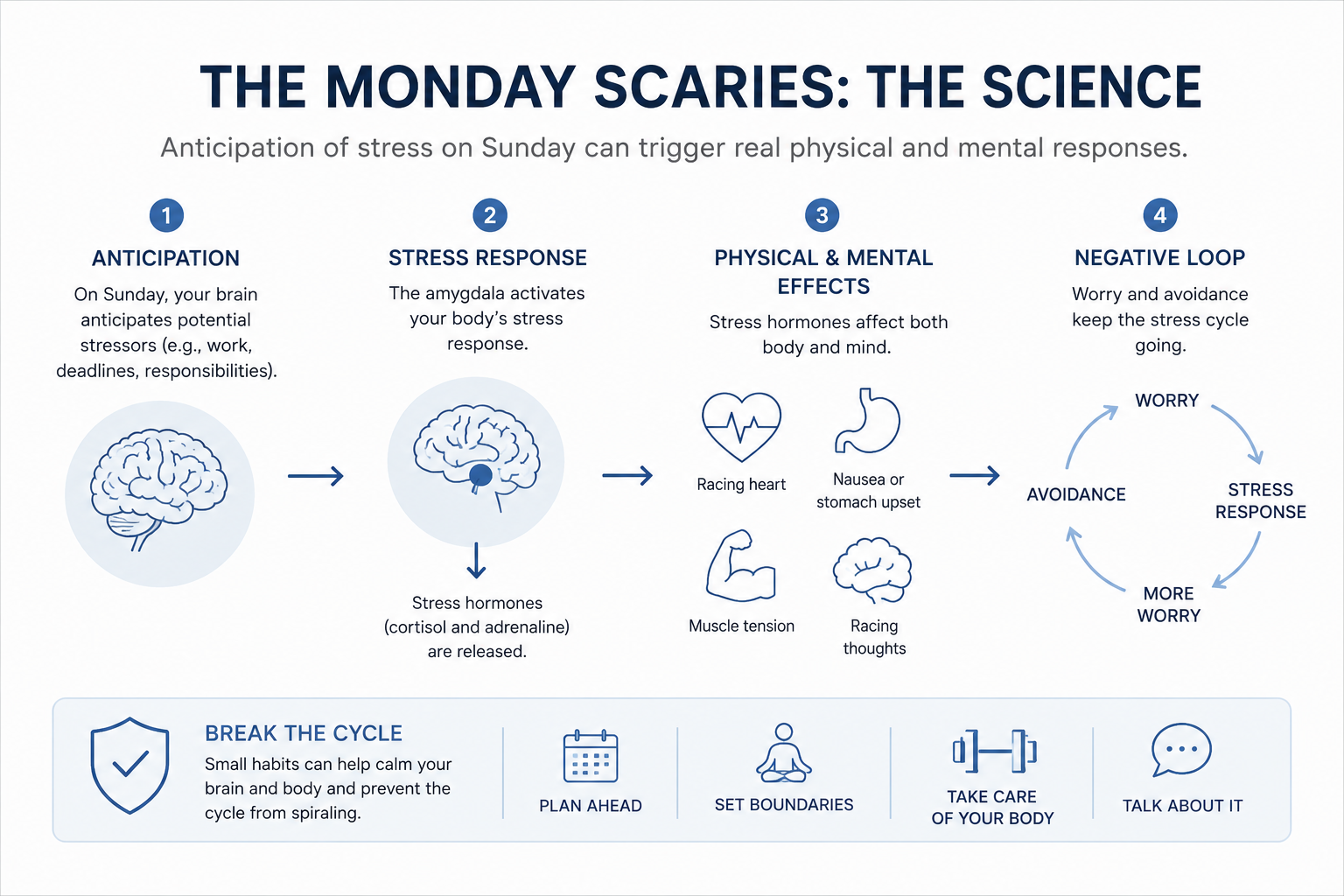
The Science Behind the Monday Scaries
As it turns out, the Monday Scaries aren't just a social media phenomenon. Researchers have been documenting a "Monday effect" for decades.
One of the most fascinating findings involves anticipatory stress—the idea that your body can react to a stressful event before it actually happens. In a study of white-collar workers, researchers found that cortisol, one of the body's primary stress hormones, was significantly higher on Monday mornings than on Sunday mornings. In other words, participants' bodies appeared to be preparing for the workweek before they had even logged on or stepped into the office (Devereux et al., 2011).
The effects aren't limited to stress hormones. A 2020 diary and actigraphy study found that workers experienced more cognitive failures on Mondays—things like forgetfulness, distraction, and mental slips. Researchers also discovered that participants took longer to fall asleep on Sunday nights, suggesting that anxiety about the upcoming week may begin disrupting sleep before Monday even arrives (Elfering et al., 2020).
What's particularly interesting is that these findings fit with a broader body of research on the brain's predictive nature. Modern theories of stress suggest that the nervous system is constantly trying to anticipate future demands rather than simply reacting to them. From this perspective, the Monday Scaries may be less about Monday itself and more about your brain running a simulation of the week ahead and preparing for what it expects is coming (Crain, Brossoit, & Fisher, 2018).
Researchers have also observed a long-standing "Monday peak" in everything from workplace accidents to cardiovascular events. A major meta-analysis of cardiovascular health found a small but consistent increase in heart-related events at the beginning of the workweek, leading researchers to speculate that the transition from weekend recovery to work demands creates a measurable physiological burden (Barnett & Dobson, 2005). While nobody is suggesting that Sunday-night anxiety causes heart attacks, the pattern highlights how deeply the workweek can affect the body.
Taken together, the research points to a simple conclusion: the Monday Scaries aren't a character flaw or a sign that you're bad at managing stress. They may be an example of your brain and body doing exactly what they evolved to do—anticipating future challenges. The real question is whether the challenges you're anticipating every Sunday night are reasonable, or whether your nervous system is trying to tell you that something needs to change.
When increasing productivity makes it worse

One of the biggest myths about the Monday Scaries is that they're a productivity problem. People often respond by trying to optimize their schedules, create better routines, or become more efficient. While those strategies can help, they don't always address the root issue. You can't organize your way out of burnout. You can't color-code your calendar into feeling fulfilled. And you can't self-care your way out of chronic stress if the underlying causes remain unchanged.
That's why I encourage people to approach the Monday Scaries with curiosity rather than frustration. Instead of asking, "How do I stop feeling anxious?" ask, "What is this anxiety trying to tell me?"
Maybe your workload has become unsustainable. Maybe you're carrying unrealistic expectations for yourself. Maybe you're navigating a major life transition. Or maybe your nervous system has been operating in survival mode for so long that it's forgotten how to fully relax.
Whatever the cause, recurring Sunday anxiety deserves attention. If the Monday Scaries have become a weekly ritual, it may be worth exploring whether they're connected to a larger pattern of stress, anxiety, or burnout. Working with a therapist can help you understand what's fueling that cycle and develop healthier ways to respond.
The goal isn't to love every Monday.
The goal is to build a life where Monday doesn't feel like something you have to survive.
About the Author
I am a licensed therapist based in Seattle, Washington, specializing in anxiety, burnout, life transitions, relationships, and perinatal mental health. My approach is warm, practical, and evidence-based, helping people understand what's happening beneath the surface so they can create lasting change—not just temporary relief. Whether you're navigating the Monday scaries, chronic stress, or a major life transition, therapy can help you feel more grounded, resilient, and connected to the life you want to live.